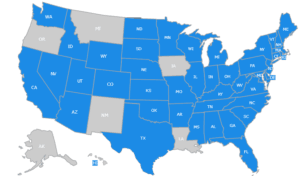
The short version: When therapy moves to telehealth across state lines, the legal and logistical details change, and the therapy itself does not. What changes is which state’s rules apply (the state where you are sitting during the session), whether your therapist holds the right license or authority there, and how emergencies and technology problems are planned for. What stays the same is the clinical work, your therapist’s ethical duties, and privacy protections under HIPAA.
People often ask me some version of the same question: “I live in one state and you practice in another. Is that allowed, and is it still real therapy?” The answer is yes, under the right conditions, and the conditions matter. This article explains what changes, what does not, and what to ask any therapist before you start, whether that is me or someone else.
Key Takeaways
- Licensure generally follows the client’s physical location during the session, not the therapist’s office and not the video platform.
- PSYPACT lets eligible licensed psychologists provide telepsychology to clients in other participating states. It applies only to psychologists, and not every state participates.
- If you travel or move, tell your therapist early. Whether sessions can continue depends on where you will be.
- Therapy, confidentiality principles, and HIPAA protections work the same way whether you are across town or across the country.
- A responsible provider confirms your location, has a plan for emergencies and technology failures, and tells you how your information is protected.
What changes, and what doesn’t, with telehealth across state lines?
| Topic | What changes | What stays the same |
|---|---|---|
| Legal authority | Your therapist needs the right license or compact authority for the state where you are during the session | Your therapist’s professional training and licensure in their home state |
| Applicable rules | State-specific laws and board rules can differ, including reporting obligations | Core ethical duties: competence, informed consent, confidentiality, avoiding harm |
| Emergencies | Local resources depend on where you are, so a plan is built around your location | The expectation that your safety is taken seriously |
| Travel and moves | Sessions may need to pause, shift, or be referred if you are in a state or country where your therapist cannot practice | The therapeutic relationship, when sessions can legally continue |
| Technology | You need a private space, a stable connection, and a backup plan if video fails | The methods, such as CBT, ACT, and psychodynamic therapy, delivered by the same clinician |
| Privacy | You share responsibility for a private setting and a secure device | HIPAA obligations for the provider and a confidential relationship |
| Insurance and fees | Network participation and coverage rules are separate from licensure and may vary by plan | The clinical value of the work |
Which state’s rules apply when you and your therapist are in different states?
The principle that guides most telehealth practice is that licensure follows the client’s physical location during the session. In the words of one 2026 industry summary of telehealth rules, licensure follows “the client’s physical location, not the clinician’s, and not the platform’s.” A video platform does not grant anyone authority to practice. The therapist needs the credential that applies where you are sitting.
Professional telepsychology guidelines from the Association of State and Provincial Psychology Boards say the same thing in practical terms. A psychologist should be aware of the client’s location, and should ensure the legal entitlement to provide services in that jurisdiction. They also note that guidelines do not supersede local law. In other words, the details are set by each state, and the therapist is responsible for knowing them.
This is why, when we first speak, I ask where you will be during sessions, and I confirm coverage for that state before we begin. It is also why this is the first question I would ask any therapist offering telehealth across state lines. For the practical side of working with me, see my virtual therapy guide, telehealth therapy, and locations pages.
How does PSYPACT fit in?
PSYPACT, the Psychology Interjurisdictional Compact, is an agreement among participating states that lets eligible licensed psychologists practice telepsychology across state lines, and practice temporarily in person, without being fully licensed in every state. A few details are worth knowing:
- It applies to psychologists only. PSYPACT’s own FAQ says it applies only to licensed psychologists. Other professions, such as counselors and social workers, have separate compacts that are at different stages.
- The psychologist needs specific authority. To provide telepsychology, a psychologist applies for an Authority to Practice Interjurisdictional Telepsychology, and must hold an E.Passport from ASPPB and a full, unrestricted doctoral-level license in a participating home state, with no disciplinary history.
- Home-state rules apply to the provider. The psychologist declares a home state where they hold a license, and PSYPACT states that they must always be physically located in that state while providing telepsychology under the compact.
- Client location matters. PSYPACT’s practice FAQ says the client must be located in a PSYPACT state, and cannot be in a non-PSYPACT state or outside the U.S.
- The psychologist must follow each state’s laws. The compact does not replace state law. Providers remain responsible for knowing and following the rules of each state they practice into.
- It is separate from billing. PSYPACT states that billing and insurance are outside its purview.
I am licensed in Massachusetts, New Hampshire, New York, and California, and I hold PSYPACT authority. Combined with those licenses, that is how I can see clients in 44 states. Compact membership changes over time, and a law being enacted does not always mean it is operating yet, so I confirm status rather than assume it. For therapy in the states where I hold a license, see Massachusetts, California, and New York.
What happens if you travel or move to another state?
This is one of the most common real-world questions, and it is where honesty matters most. Because authority depends on where you are, the answer depends on where you are going.
- Traveling within states where your therapist can practice. Sessions can usually continue as planned. Students home for the summer and professionals who split time between states are common examples.
- Traveling somewhere your therapist is not authorized. That might be a state outside the compact, or another country. Sessions may need to pause, or you may need a different kind of support for that period. A phone call does not change the rule, because the location is what matters.
- Moving. Continuity is possible if your new state is covered. If it is not, a thoughtful transition and referral is part of good care.
The practical advice is simple: tell your therapist before you travel or move, and ask early. See life transitions therapy and therapy for college students for common situations.
What does not change when therapy goes across state lines?
The therapy itself
The same evidence-based approaches are delivered on video, including CBT, ACT, and psychodynamic therapy. I explain the research and how I use these methods in is virtual therapy as effective as in-person and online therapy approaches, techniques, and outcomes.
Privacy protections
Telehealth is covered by the same privacy law as in-person care. The U.S. Department of Health and Human Services states that all telehealth services provided by covered providers must comply with the HIPAA Rules, and that providers should use vendors who will enter into business associate agreements. That is why I use a secure videoconferencing platform built for healthcare, not a consumer video app. Different states may set their own rules on top of HIPAA, which is another reason local law matters.
Your therapist’s duties
The limits of confidentiality, such as serious risk of harm and mandatory reporting, still apply, and specific legal details can vary by state. Informed consent should cover telehealth explicitly, as the ASPPB guidelines recommend, including the risks to data security. Read more about how we work in practice policies and therapy FAQs.
What practical things are arranged differently?
- Knowing your location. Your therapist should know where you are physically at the start of each session, especially if it can vary.
- An emergency plan. The ASPPB guidelines recommend that psychologists identify and learn how to access emergency resources in the client’s local area. A therapist in another state cannot send help the way a local office can, so the plan should be set up in advance, not in the moment.
- A technology backup. If video fails, we switch to phone and continue. I ask clients to agree on that plan with me in advance.
- A private space. HHS advises holding telehealth appointments in a private location, using headphones if privacy is limited, turning off nearby smart devices, avoiding public Wi-Fi, and using strong passwords with multi-factor authentication where available.
- Safety while driving. I do not conduct sessions while a client is driving.
- Coverage and fees. Insurance and network rules are separate from licensure, so confirm coverage with your plan. See how superbills work for out-of-network therapy and online therapy through a private practice vs. platforms.
What should you ask any telehealth therapist?
- Are you licensed or authorized to treat me in the state where I will be during sessions? A clear, specific answer is a good sign.
- What happens if I travel or move? Ask what they can and cannot do.
- How do you handle emergencies when we are in different places?
- What platform do you use, and how is my information protected?
- What are your fees, and what is and is not covered by insurance?
- What if telehealth is not working for me? A good therapist will tell you when in-person care might fit better.
You can also verify credentials yourself. State licensing boards publish license lookups, and PSYPACT maintains public records of psychologists’ authorizations. For help finding the right fit, see how to find a good therapist, what is a clinical psychologist, and therapist finders compared.
When in-person care is the better choice
Telehealth is not for everyone. It may not fit if you cannot find a private space, if your therapist uses a method that needs physical presence, such as standard EMDR or play therapy with younger children, or if you simply do not feel connected on screen. In those cases I refer to in-person colleagues. See what a therapy appointment is like for what to expect either way.
Wondering whether I can work with you where you live?
Start with a free consultation. We will confirm the state where you will be, talk through your goals, and make sure telehealth is a good fit before you commit.
Schedule a Free Consultation Read the Virtual Therapy GuideFrequently asked questions
Can a therapist see me if I live in a different state?
Often yes, but only if they hold the right license or authority for the state where you are during the session. Licensure generally follows the client’s physical location, not the therapist’s office. Some psychologists can practice across state lines through PSYPACT, and others hold multiple state licenses. Ask your therapist directly whether they are authorized to treat you where you will be sitting.
What is PSYPACT?
PSYPACT is an interstate compact that allows eligible licensed psychologists to provide telepsychology, and temporary in-person services, in other participating states without full licensure in each. The psychologist must hold a full, unrestricted doctoral-level license in a participating home state, an E.Passport, and authorization from the PSYPACT Commission. It applies only to psychologists, and not every state participates, so coverage depends on the states involved.
Can I continue therapy if I travel or move to another state?
Sometimes. If your therapist is authorized in the state where you will be, sessions can usually continue. If you are traveling somewhere they cannot practice, such as a state outside the compact or another country, sessions may need to pause. Tell your therapist before you go, because planning ahead makes it easier to keep care continuous or arrange a transition if you move.
Is telehealth therapy across state lines as private as in-person?
It can be, with the right setup. Telehealth services by covered providers must comply with HIPAA, and a good provider uses a secure platform built for healthcare and discusses data security in the consent process. Your part matters too: use a private room, headphones if needed, a secure device and connection, and strong passwords. Ask what platform your therapist uses and how your information is protected.
What happens in an emergency if my therapist is in another state?
Your therapist cannot dispatch help directly across the country, so a plan needs to be made in advance. Professional telepsychology guidelines recommend that psychologists identify and learn how to access emergency resources in the client’s local area. Ask your therapist how they confirm your location, what local emergency information they keep, and what they will do if you cannot be reached during a session. In the U.S., you can call or text 988 or call 911 in a crisis.
How can I check that my therapist is allowed to treat me in my state?
Start by asking them to name the license or authority that covers your state. Then verify it. Most state licensing boards offer online license lookups, and PSYPACT publishes records of psychologists who hold its authorizations. Because compact membership and state rules change, a therapist should be able to explain their coverage clearly and confirm it again if your location changes.
Official sources and further reading
- PSYPACT Commission. Practicing Telepsychology Under PSYPACT.
- PSYPACT Commission. Practice FAQs.
- PSYPACT Commission. Frequently Asked Questions.
- PSYPACT Commission. Practicing Temporarily under PSYPACT.
- U.S. Department of Health and Human Services. HIPAA Rules for telehealth technology.
- U.S. Department of Health and Human Services. Telehealth Privacy and Security Tips for Patients.
- Association of State and Provincial Psychology Boards. Telepsychology Guidelines (draft, April 2013).
- Triad. Telehealth across state lines (September 2026).
This article is educational and is not legal advice. Licensure rules, compact membership, and state laws change, so confirm current requirements with your state licensing board and your provider. If you are in crisis, call or text 988 in the U.S., or go to the nearest emergency room.


 Alan Jacobson, Psy.D., MBA, is a licensed clinical psychologist and Director of the Foresight Psychological Institute.