As a psychologist who has delivered thousands of hours of telehealth, I no longer view online therapy as a substitute for office-based care. It is its own distinct modality with its own clinical advantages: clients engage from their real environments, exposures occur in vivo, executive functioning supports are built directly into daily routines, and emotionally charged patterns emerge naturally rather than being artificially contained within an office. Many clients report something else, too — that opening up is easier from familiar surroundings. Shame softens. Vulnerability deepens. Sessions become collaborative working meetings rather than formal appointments.
This article covers how the major evidence-based approaches are adapted for online delivery, and what treatment actually looks like across five very different cases. (For the research on whether online treatment works as well as in-person, see my full review of the effectiveness evidence; for logistics, fees, and how sessions run in my practice, see the Complete Virtual Therapy Guide.)
It Starts With Assessment, Not a Menu
In my practice, telehealth is never one-size-fits-all. Each engagement begins with careful assessment — often integrating cognitive, executive functioning, emotional, and personality-based measures — so the approach matches not only the diagnosis but the person’s learning style, goals, and life context. Whether the focus is anxiety, ADHD, OCD, burnout, or deeper identity and relational patterns, the plan is built to be strategic, strengths-based, and sustainable. The result is not just improvement, but momentum.
Core Approaches, Adapted for Online Work
- Cognitive Behavioral Therapy (CBT): shared screens turn thought records, behavioral experiments, and exposure hierarchies into live collaborative documents. Strong online for anxiety, depression, insomnia (CBT-I), panic, perfectionism, and performance concerns.
- Exposure and Response Prevention (ERP): arguably stronger online — the feared triggers for OCD live at home, in the car, at the sink, and virtual sessions let exposures happen exactly where the compulsions do.
- Schema Therapy: longer-term work on lifelong emotional patterns rooted in early experience. The relational depth translates fully to video, and meeting clients in their own space often surfaces the patterns faster.
- ADHD treatment and executive functioning coaching: systems get built in the actual environment where they’ll be used — the real desk, the real calendar, the real morning routine — instead of described secondhand.
- Panic-focused interventions: interoceptive exposure and skills practice can happen in the settings where panic actually strikes, with support in the room (virtually) the first times through.
Five Cases, Five Models, One Platform
These examples — composites drawn from my practice with details altered to protect privacy — were selected to show range: online therapy is not a single technique but a platform for delivering many evidence-based models with precision and real-world relevance.
The executive whose burnout wasn’t about workload
A high-performing leader arrived with classic burnout — exhaustion, cynicism, dread. Assessment pointed deeper: an unrelenting-standards pattern rooted in early experience, driving overcommitment no schedule change could fix. Schema-focused work over video traced the pattern to its origins and restructured it; meeting during his workday, in his actual office, meant the material was never abstract. The burnout resolved because its engine did.
The young adult whose OCD lived in her apartment
Contamination-focused OCD had organized her entire home around avoidance. In-office treatment would have meant describing her kitchen; virtual treatment meant being in it. Exposures were conducted live in the exact locations the compulsions occurred, with response prevention coached in real time. Progress that typically takes months of generalization from office to home happened directly, because there was no gap to generalize across.
The professional with anxiety and 2 a.m. rehearsals
Chronic worry, insomnia, and pre-meeting dread responded to structured CBT with CBT-I: shared-screen thought records, behavioral experiments between sessions, and a sleep protocol tracked collaboratively. Sessions scheduled over lunch — impossible with a commute — kept treatment consistent through his busiest quarter, which was precisely when he needed it.
The graduate student whose systems never survived the week
Every planner and app had failed her because they’d been designed in the abstract. Camera in hand, we built the system in her real workspace — the actual desk, the actual whiteboard, the actual Sunday-evening reset — and troubleshot it live when it wobbled. Combined with treatment for the shame the ADHD had accumulated, the difference wasn’t just organization; it was self-trust.
The new parent whose panic attacks arrived in the car
Panic had started on highway drives and was spreading. Treatment combined interoceptive exposure with graded real-world practice — early sessions from home, later check-ins conducted moments before planned drives, the virtual equivalent of a clinician in the passenger seat. The “booster before the trigger” structure that telehealth makes possible turned out to be the treatment’s backbone.
The common thread: in each case, therapy happened where the problem lived. Online therapy is not a diluted version of care — it’s a platform that lets treatment live where life actually unfolds, creating change that is durable in the world beyond the session.
Online Therapy Approaches: Frequently Asked Questions
Which therapy approaches work well online?
How do you decide which approach to use?
Can intensive treatments like ERP or Schema Therapy really be done over video?
What outcomes can I expect from online therapy?
Find the Right Approach for Your Situation
Schedule a free consultation. We’ll discuss what you’re facing and which treatment model fits — designed around assessment of your actual situation, not a one-size-fits-all program.
Schedule a Free ConsultationMore Frequently Asked Questions: Online Therapy
Common questions about how online therapy works, who it helps, and what to expect from virtual treatment.
Is online therapy as effective as in-person therapy?
Yes — and in some respects it can be more effective. A large and growing body of research supports the clinical equivalence of telehealth and in-person treatment across a wide range of conditions, including anxiety, depression, OCD, ADHD, and trauma. Beyond equivalence, online therapy offers a clinically meaningful advantage called ecological validity: interventions happen in the client’s real environment — their home, dorm, office, or car — rather than in a neutral office setting. Exposures occur in vivo, executive functioning supports are built directly into daily routines, and emotional patterns emerge naturally. This often accelerates and deepens the work.
What conditions and approaches can be treated effectively online?
Online therapy supports the full range of evidence-based treatment models. Dr. Jacobson delivers CBT online for depression and anxiety, Exposure and Response Prevention (ERP) for OCD, Schema Therapy for deep-rooted emotional patterns, ADHD therapy and coaching, panic-focused treatment, and integrated treatment for depression and anxiety. Telehealth is not a reduced version of these approaches — it is a platform that enables their full delivery, often with greater real-world relevance and between-session integration than office-based work alone.
What are the practical advantages of doing therapy online?
Beyond clinical effectiveness, online therapy offers significant practical benefits. It eliminates commute time, removes geographic barriers, and makes it far easier to maintain consistent attendance — one of the strongest predictors of good treatment outcomes. It supports continuity of care during relocations, travel, illness, or demanding life stages. Many clients also report feeling more comfortable opening up in their own environment — shame softens, and sessions take on a collaborative, working-meeting quality rather than a formal clinical one. For students, the ability to continue therapy between semesters without interruption is particularly valuable.
Can complex treatments like Schema Therapy or ERP really be done via video?
Yes — and the case examples on this page illustrate exactly how. Schema Therapy online uses digital inventories, shared whiteboard life-timeline mapping, screen-partitioned chair dialogues between schema modes, guided imagery rescripting with recorded audio for daily playback, and digital schema flashcards. ERP for OCD is delivered via in-home exposure coaching over video — which is actually a clinical advantage, since contamination and other OCD triggers live in the home environment, not in a therapist’s office. Complex treatment is not just possible online; the format often makes it more precise and contextually relevant than office-based delivery.
Can I see Dr. Jacobson online if I live in a different state?
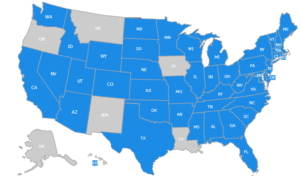
In most cases, yes. Dr. Jacobson is a PSYPACT-participating psychologist licensed to practice in 44 states. This means clients can begin therapy in one location and continue without interruption if they relocate, travel, or split time between states. It also makes Dr. Jacobson accessible to clients in states where specialized services — such as OCD therapy, fear of flying treatment, or sports psychology — may not be readily available locally. A full list of covered states is available on the locations page.
How is an online therapy session actually structured?
Sessions follow the same clinical structure as in-person appointments — typically 45–55 minutes — with the addition of tools that enhance the virtual format. These include screen sharing for live completion of thought records, cognitive maps, or planning documents; shared digital workspaces for between-session skill tracking; and, where clinically indicated, real-time in-vivo coaching during exposures or behavioral experiments. Session recordings (with consent) allow clients to revisit key interventions. The goal is not to replicate the office experience online but to build a richer, more embedded form of treatment that meets clients where their lives actually unfold.
What’s the difference between online therapy and apps or AI-based mental health tools?
Online therapy with a licensed psychologist is clinical treatment — individualized, diagnostically informed, and delivered by a credentialed professional with ethical and legal accountability. Apps and AI-based tools can be useful adjuncts for mood tracking, psychoeducation, and between-session skill reinforcement, and they represent an exciting area of emerging innovation in telehealth. However, they are not substitutes for clinical assessment, diagnosis, or the therapeutic relationship that drives meaningful and lasting change. Dr. Jacobson’s practice integrates evidence-based digital tools where appropriate while keeping the clinical relationship at the center of care. For more on emerging innovations, see the best online therapy guide.
How do I know if online therapy is the right fit for me?
The best way to find out is through a free 20-minute consultation. In that conversation, Dr. Jacobson will ask about what you’re experiencing, what approaches you may have tried, and what your goals are — and you’ll get a candid sense of whether online therapy, and this particular fit, makes sense. Most people find the conversation more straightforward than they expected. You can also explore the guide to choosing a therapy approach and the virtual therapy guide for more context before reaching out.
Ready to get started with online therapy?
Schedule a free 20-minute consultation with Dr. Jacobson. No commitment required — just an honest conversation about where you are and what might help. Schedule a Free Consultation


 Alan Jacobson, Psy.D., MBA, is a licensed clinical psychologist and Director of the Foresight Psychological Institute.