
After 25 years and training across more than twenty evidence-based approaches, here’s exactly how I figure out what will actually work for you — and why no two treatment plans I write look the same.
Therapy isn’t one-size-fits-all, and I don’t think it should be practiced like it is. Over 25 years, I’ve trained across more than twenty clinical approaches — CBT, ACT, EMDR, Schema Therapy, Polyvagal-informed work, and more, all covered on my Types of Therapy page — not to have a favorite, but to have options. My job in our first few sessions isn’t to fit you into whichever modality I happen to reach for first. It’s to understand you well enough to braid together the specific combination of techniques that fits your goals, your history, and how you actually respond to treatment.
I call that process MATCH. It’s the same framework whether you’re coming in for individual therapy, couples work, family therapy, or coaching — the modalities change, the process for choosing them doesn’t.
The MATCH framework
Five steps, applied to every client relationship regardless of what brings you in:
Multidimensional Assessment
I start by understanding the whole picture — your history, relationships, physiology, goals, and what’s already been tried — not just the symptom that brought you in.
Applied Psychological Science
Every technique I draw on is grounded in the clinical research base, not instinct alone — the same evidence-first standard behind everything at the Center for Applied Psychological Science.
Tailored Integrative Plan
From there, I build a plan drawn from the more than twenty approaches I’ve trained in — chosen specifically for you, not a fixed protocol everyone gets.
Continued Collaboration and Measurement
Therapy isn’t “set it and forget it.” We track what’s actually working using measurable, meaningful markers of progress, and I adjust the plan as we go rather than sticking with something that isn’t landing.
Holistic Integration
The techniques above aren’t used in isolation — I braid them together into one coherent approach that addresses mind and body, thought and emotion, individual and relational context, so treatment fits the whole person, not just a diagnosis.
Why I don’t practice one-size-fits-all therapy
Most therapists are trained deeply in one or two modalities and use them for nearly everyone who walks through the door — which works well for some people and poorly for others, largely by chance. Twenty-five years of practice gave me the alternative: enough breadth across evidence-based approaches that I’m not choosing your treatment based on what I know best, but on what actually fits your goals, your history, and your physiology. MATCH is the discipline that keeps that choice deliberate instead of habitual.
Who I work with using this approach
The MATCH framework underlies every kind of work I do. Explore how it applies to your situation:
- Individual Therapy
- Couples Therapy
- Family Therapy
- Group Therapy
- Executive Coaching
- ADHD Coaching
- Anxiety Therapy
- Life Transitions
- Full List of Therapy Types
About Dr. Jacobson
I’m a licensed clinical psychologist with 25+ years of experience, licensed in Massachusetts, California, New Hampshire, and New York, with PSYPACT authority covering telepsychology across 44 states. My approach is grounded in positive psychology and humanistic values — strength-based, future-oriented, and collaborative — applied through whichever combination of evidence-based techniques actually fits you. You can read more on my full bio.
Frequently asked questions
What does MATCH stand for?
MATCH is the five-step process I use to build every treatment plan: Multidimensional Assessment (understanding the whole person), Applied Psychological Science (grounding every technique in clinical research), Tailored Integrative Plan (selected from more than twenty approaches I’ve trained in), Continued Collaboration and Measurement (tracking progress and adjusting as we go), and Holistic Integration (braiding techniques together into one coherent approach). It’s the same process whether you’re starting individual therapy, couples work, family therapy, or coaching.
Do I need to know which type of therapy I want before we start?
No — that’s the point of the MATCH process. Most clients come in describing what they’re struggling with, not which modality they’d like. I use our first several sessions to understand your history, goals, and how you respond to different approaches, then build the plan from there. You’re welcome to ask about specific techniques you’ve read about, like EMDR or ACT, and we can talk through whether they fit.
How is this different from typical single-approach therapy?
Many therapists practice one or two modalities and apply them broadly, which works well for some clients and less well for others, often by chance rather than fit. Because I’ve trained across more than twenty evidence-based approaches, I can select and combine techniques based on what actually matches your situation, rather than being limited to whichever framework I know best.
How soon will I notice results?
Most clients notice real, measurable change within 4–6 sessions. That timeline reflects the Continued Collaboration and Measurement step of MATCH — I’m tracking meaningful markers of progress from early on, so if something isn’t working, we adjust rather than waiting months to find out.
What if the plan needs to change partway through?
That’s expected, not a failure of the original plan. People change, circumstances change, and what worked in month one isn’t always what’s needed in month six. The Continued Collaboration and Measurement step exists specifically so the plan can evolve with you rather than staying fixed once it’s set.
Curious how MATCH would apply to you?
A free, 20-minute consultation is the easiest way to start — no commitment, just a conversation about what you’re working through.
Schedule a Free Consult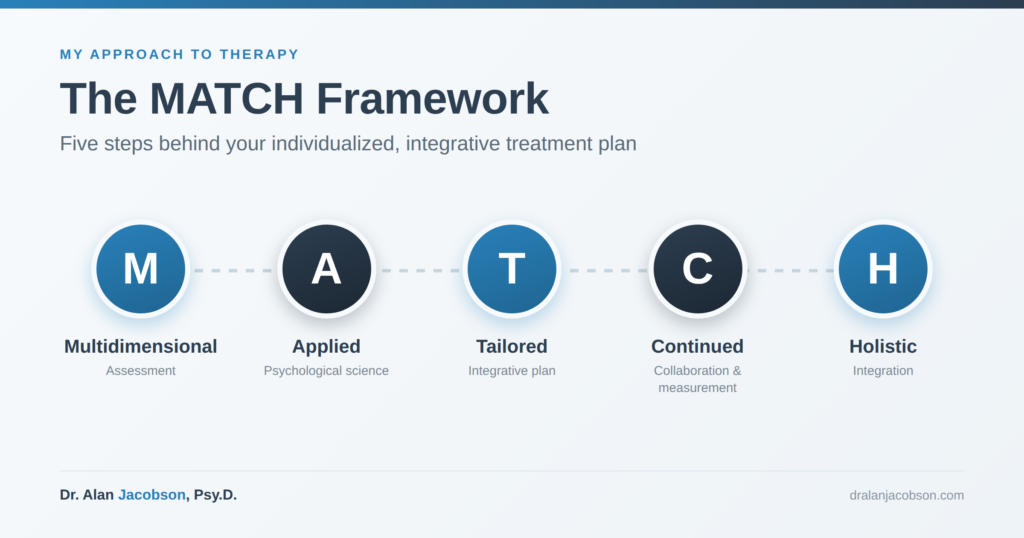
One closing thought, from me directly: MATCH isn’t a framework I built to sound impressive on a page. It’s genuinely how I organize twenty-five years of training so that it’s useful to the specific person in front of me, not just tidy on a shelf. If any of this resonates with what you’re working through, I’d like to hear about it.— Dr. J.


