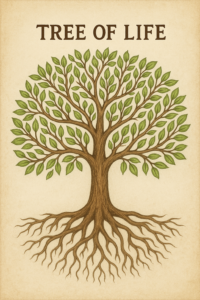
Tree of Life therapy is a narrative-based approach that uses the metaphor of a tree to help individuals explore their life story, strengths, and future goals. Representing different parts of life, such as roots (past), trunk (strengths), and branches (hopes), helps people build resilience and a stronger sense of identity.
Key elements include:
Exploring your past, identity, and personal story
Identifying strengths, values, and support systems
Reframing difficult experiences in a more empowering way
Building hope, direction, and resilience
When Is Tree of Life Therapy Used?
Trauma, stress, or difficult life experiences
Low self-esteem or identity struggles
Children, teens, or individuals who benefit from creative expression
Life transitions or feeling stuck
This approach is especially effective because it focuses on strengths and allows people to share their stories in a safe, non-threatening way.
How Tree of Life Therapy Works
Roots: your history, culture, and influences
Trunk: your strengths, values, and skills
Branches: your hopes, goals, and future direction
Leaves/Fruits: important people and supports in your life
This structured, visual process helps organize life experiences into a coherent and empowering narrative.
Introduction to TOLT
As a psychologist who uses narrative therapy and strengths-based approaches in my work, I often reach for the Tree of Life Therapy activity when people need a safe, non-threatening way to tell their story without being retraumatized. It’s simple, visual, and empowering: instead of digging for pathology, we map resources, relationships, hopes, and history. The goal of Tree of Life Narrative Therapy is to help people notice the skills and connections that have sustained them and to expand possibilities for a preferred future.
Tree of Life Therapy History & Background
The Tree of Life Therapy approach emerged in the early 2000s during community-based psychosocial work in Southern Africa. At that time, practitioners were seeking ways to support children and families affected by HIV/AIDS, war, displacement, trauma, poverty, and systemic oppression. Traditional Western diagnostic approaches were not culturally aligned, often re-traumatizing, and did not acknowledge the rich cultural knowledge, communal identity, and spiritual traditions that sustained these communities.
Tree of Life Therapy Origins and development
Ncazelo Ncube, a Zimbabwean psychologist and community worker, co-created Tree of Life Therapy while working at REPSSI (Regional Psychosocial Support Initiative).
David Denborough and colleagues at the Dulwich Centre helped refine, document, and disseminate the Tree of Life Therapy approach internationally.
The method draws heavily from narrative therapy, especially Michael White and David Epston’s ideas of externalizing problems, honoring cultural knowledge, and re-authoring identity through story. It is sometimes referred to as Tree of Life Narrative Therapy.
Why a tree?
This metaphor was intentionally chosen because:
Trees hold deep cultural, spiritual, and ecological meaning across many societies.
They illustrate growth, rootedness, nourishment, storms, resilience, and interconnectedness.
The visual nature of drawing a tree gives participants distance and emotional safety while exploring identity.
Global expansion
Over time, the Tree of Life Therapy activity spread to:
Schools, community centers, refugee camps, and crisis-response programs
Because it is non-pathologizing, adaptable, and culturally inclusive, it has become one of the most widely disseminated narrative-based group interventions globally.
What the Tree of Life Therapy Activity is Used For
The Tree of Life Therapy activity is a flexible psychosocial and therapeutic tool. It is used across individual, group, educational, and community settings to achieve a range of emotional, clinical, and developmental goals.
Primary uses of the Tree of Life Therapy Activity include:
Trauma-informed emotional support
The Tree of Life exercise helps people tell their story without reliving traumatic memories.
It allows clients to contextualize difficulties (“storms”) rather than internalizing shame.
Strengths-based identity reconstruction
The Tree of Life Therapy activity is beneficial for people whose identities have been diminished by hardship, stigma, or labels (e.g., “refugee,” “disabled,” “at-risk youth”).
It encourages participants to reclaim narratives of capability, survival, and purpose.
Enhancing resilience and coping skills
Identifies protective factors (values, skills, relationships) that can be strengthened.
Helps map internal and external resources.
Supporting children and adolescents
The Tree of Life Therapy activity can be used in schools facing community violence.
It can help youth experiencing grief, academic stress, bullying, or family conflict.
It helps foster care and adoption transitions
The Tree of Life exercise can help with self-esteem building
Grief, loss, and life transitions
The Tree of Life exercise allows safe acknowledgment of loss without forcing emotional exposure.
It is helpful for medical diagnoses, chronic illness, retirement, immigration, or role changes.
Community healing and collective meaning-making
Grouping trees and communal storytelling fosters solidarity, empowerment, and shared purpose.
It is commonly used in humanitarian contexts.
Clinical therapy integration
The Tree of Life Therapy activity is rapport-building
It can also be an early-phase narrative assessment
The Tree of Life exercise is a values and strengths clarification tool
It is also a grounding technique before deeper trauma work
It can be a creative intervention during stalled therapy processes
In essence, the Tree of Life Therapy activity is used wherever a gentle, empowering, culturally adaptable method of exploring identity and resilience is needed.
The Tree of Life Exercise
The Tree of Life Therapy activity uses tree parts as metaphors. Facilitators guide participants in drawing or creating a tree, then in naming and exploring each part. Below is a typical structure and therapeutic purpose for each element.
Preparation & safety
Explain the purpose of the Tree of Life Exercise, gain consent, and set limits (this is strengths-mapping, not trauma processing). Emphasize that participants decide what to share.
Materials: paper, markers, stickers; for groups, create a calm, private space.
Roots — “Where you come from.”
Prompt: “Who or what has fed you and shaped you?” (family, cultural roots, important places, traditions)
Purpose: grounds identity, acknowledges history and cultural resources.
Ground/Soil — “Current life & context.”
Prompt: “What is happening in your life right now?” (school, community, challenges, daily routines)
Purpose: locates the person in the present context without pathologizing.
Trunk — “Skills, values, strengths.”
Prompt: “What skills and values keep you standing? What helps you cope?”
Purpose: externalizes and names capacities (problem-solving, humour, persistence).
Branches — “Hopes and dreams.”
Prompt: “What do you want to grow toward?” (goals, wishes, aspirations)
Purpose: future-oriented, creates agency and possibility.
Leaves — “People who support you.”
Prompt: “Who are the people (or animals, places) you can rely on?”
Purpose: maps social support and attachment figures.
Fruits/Gifts — “Gifts you’ve received or can share.”
Prompt: “What gifts or talents have you been given?” (skills, cultural knowledge, kindness)
Purpose: reinforces strengths and what can be shared with others.
Storms/Challenges (sometimes drawn as clouds, stones, or pests)
Prompt: “What has made growing hard?” (loss, discrimination, illness)
Purpose: acknowledges hardship in a contained way so it doesn’t dominate the whole story.
Reflection and re-authoring
I then elicit stories that explain each element, externalize problems (e.g., “the storm” rather than “you are broken”), explore unique outcomes (times when problems were resisted), and collaborate on meaning and next steps.
Closing & Linking
Together, we link strengths on the picture to practical steps (e.g., trunk skills that can be used to reach branch goals). Optionally create a shared group picture or take home a copy. For groups, include communal rituals that honour stories.
Therapeutic mechanisms: externalization, strengths amplification, meaning-making, social reconnection, cultural validation, and future orientation. The exercise is deliberately adaptable — it can be a single session, a brief series, or part of a more extended therapy plan.
Combining the Tree of Life Exercise with Other Methods
The Tree of Life exercise pairs well with several therapeutic approaches:
Narrative therapy is rooted in narrative ideas—sometimes referred to as Tree of Life Narrative Therapy —and uses narrative questions to deepen re-authoring.
Trauma-informed care: use it as a safe, low-arousal option before any trauma processing; it helps build resources first.
Art therapy & creative therapies: the drawing and metaphorical work align naturally with art and music interventions.
CBT/Skills training: after identifying trunk skills, you can teach specific behavioral or cognitive skills to strengthen those capacities.
Family therapy/systemic work: create family trees or shared community trees to map relational strengths and obligations.
Group psychosocial interventions: The Tree of Life Therapy activity is used in schools, camps, or humanitarian responses to build collective resilience.
Practical tips for clinicians/facilitators
Respect cultural meanings — ask about tree symbolism in the person’s culture.
Keep it strengths-first: only invite naming of storms if participant chooses; avoid intrusive probing.
Use creative variations: collages, clay, artificial intelligence, and group mural.
Use it as an entry point: follow up with targeted interventions (skills teaching, family work, trauma-informed processing) as needed.
Limitations & cautions
The Tree of Life therapy activity is not a standalone trauma treatment for severe PTSD — it’s a resource-building, narrative exercise best used within a trauma-informed care plan.
Therapists must avoid minimizing real harm; storm themes should be acknowledged and, if needed, referred for appropriate clinical care.
Adapt language and delivery to developmental level, literacy, and cultural context.
Tree of Life Therapy Case Examples
The following case examples help illustrate how the Tree of Life activity is used in therapy.
1. Tree of Life Narrative Therapy with a Teen
Maya, grieving her mother’s death, avoided discussing emotions and experienced panic attacks. She felt fragile, ashamed of “breaking down,” and disconnected from her peers.
Tree of Life Narrative Therapy Work
Establishing safety & consent
I emphasized that the Tree of Life exercise was not about “talking about the trauma” but about understanding who she is as a person. This reduced panic and defensiveness.
Roots exploration
I helped Maya identify small but meaningful memories—cooking with her mother, the smell of jasmine in their yard. These were framed as resources rather than triggers. I gently mirrored: “Your mother taught you care, and creativity, and those qualities are still alive in you.” This reframing allowed Maya to feel connected to her mother without overwhelming sadness.
Trunk strengthening
When Maya minimized her strengths (“I just doodle”), I used narrative practices:
Externalizing the self-critic (“That’s the Doubting Voice speaking”)
Highlighting unique outcomes (“Tell me a time your art helped you calm down”)
Thickening the story of values (“What does art allow you to express?”), Maya recognized her creativity as an active coping tool.
Linking branches to real goals
I translated hopes (art classes, completing a memorial art project) into actionable steps:
A weekly art practice routine
Enrolling in an after-school art program
Creating a timeline for the memorial project
Storms reframed
Panic was externalized as “the wave,” something that visits rather than defines her. She learned grounding skills using imagery from her picture (e.g., “feel your roots,” “focus on the solid trunk”).
Tree of Life Narrative Therapy Outcome
Within six weeks, panic attacks reduced, school attendance improved, and she displayed more emotional openness. Maya reported feeling “more like myself again” rather than “the girl whose mom died.”
2. Tree of Life Narrative Therapy with a Young Adult
Omar felt rootless, isolated, and ashamed that nightmares and memories intruded at night. He felt pressure to “be strong” and hide distress.
Tree of Life Narrative Therapy Activity
Strengths-based cultural validation
To start Tree of Life Narrative Therapy, I highlighted the significance of his roots—language, cooking, and community traditions. This countered the dominant narrative: “I am a displaced person.”
He instead began to narrate: “I come from a culture of hospitality and resilience.”
Social scaffolding through group sharing
Sharing leaves (supportive people) helped him realize he was not alone. He heard others’ stories and felt a sense of belonging. Through Tree of Life Narrative Therapy, I offered metaphors of support (“your trunk is strong even in storms”), which strengthened communal identity.
Externalizing trauma symptoms
Nightmares were described metaphorically as “night storms,” visiting rather than defining him.
Questions included:
“When the storms visit, what helps your tree stay standing?”
“Which strengths from your trunk help you face them?”
This reduced shame and normalized his experience.
Linking strengths to future plans
His identified talents—fixing radios, storytelling—were connected to local training opportunities.
He created a clear path:
Enroll in a technical workshop
Volunteer once weekly, fixing donated electronics
Attend a peer support group for connection
Tree of Life Narrative Therapy re-authoring
Rather than “I survived by accident,” the group explored narratives of intention, courage, and persistence during their migration. This thickened a preferred identity: “I am resourceful and committed.”
Outcome
Omar developed friendships, joined training programs, and reported fewer episodes of isolation. His sense of identity broadened beyond survivorhood into contribution and purpose.
3. Tree of Life Exercise with an Adult
Sheila’s chronic illness forced her early retirement from a career she loved. She felt useless, depressed, and disconnected from her sense of competence.
Tree of Life Exercise
Honoring roots without idealizing the past
I helped Sheila revisit her history of leadership, community service, and creativity. The goal was to reclaim identity, not deny present limitations.
Slow, mindful trunk-building
Sheila initially dismissed her skills (“They don’t matter anymore”). I used micro-narratives:
Times when her organizational skills helped her manage medical appointments
Moments when her listening skills supported friends
She showed acts of quiet resilience daily
Reclaiming agency through branches
We divided her goals (writing memoir pieces, starting a baking circle) into gentle, manageable steps:
Choosing one small baking project per week
Writing for 5 minutes daily
Asking neighbors if they’d join a monthly circle
I emphasized that growth can be slow—trees grow incrementally.
Mapping support and reducing isolation
Sheila realized she had more leaves (supportive people) than she recognized. She strengthened these connections, increasing resilience.
Naming storms and coping tools
We externalized shame, fatigue, and fear of judgment.
I helped her build a plan using metaphors:
“Roots” → grounding techniques
“Trunk” → pacing strategies
“Leaves” → asking for help
“Branches” → future-oriented motivations
Tree of Life Exercise Outcome
Sheila regained a sense of purpose, experienced fewer depressive episodes, and successfully launched a monthly community baking group. She reported feeling “alive again,” with her identity now broader than her illness.
Conclusion and My Work
The Tree of Life is a gentle, empowering, narrative-based method that helps people reclaim identity, recognize strengths, and build resilience. It works across cultures, age groups, and therapeutic contexts by avoiding pathologizing individuals and instead amplifying the skills and supports that sustain them. When used skillfully, it provides both emotional safety and creative space for healing, identity reconstruction, and future-oriented hope.
If you have questions about Tree of Life Narrative Therapy or would like to learn more about how the Tree of Life Therapy activity might benefit you, don’t hesitate to contact me or schedule a consultation at any time.
Frequently Asked Questions: Tree of Life Therapy
Common questions about Tree of Life therapy — what it is, how it works, and who benefits most from this narrative-based approach.
Tree of Life therapy is a structured therapeutic approach developed by Ncazelo Ncube-Mlilo and David Denborough at the Dulwich Centre in Adelaide, Australia — one of the world’s leading centers for narrative therapy practice and training. It uses the metaphor of a tree to help clients explore and articulate different dimensions of their lives and identity: the roots (where you come from, your heritage and values), the ground (your current daily life), the trunk (your skills, knowledge, and strengths), the branches (your hopes, dreams, and future direction), the leaves (the important people in your life), and the fruits (what you give to others). Originally developed for working with children from vulnerable communities, the approach has been widely adapted for individual adults, groups, families, and clinical populations including trauma survivors, people experiencing grief and loss, and those navigating significant life transitions. It is grounded in the broader framework of Narrative Therapy, which was developed by Michael White and David Epston and centers on the idea that the stories we tell about ourselves shape our identity — and that those stories can be consciously examined and rewritten.
The process unfolds across several phases. In the early phase, clients are guided to create their own visual or written Tree of Life — exploring each part of the metaphor in structured conversation with the therapist. This is not simply a drawing exercise; each element prompts specific narrative questions designed to surface strengths, values, connections, and aspirations that problem-saturated storytelling has often obscured. The middle phase introduces the “storms” — the difficulties, losses, and challenges that have affected the person’s life — but importantly, these are approached from a position of strength rather than from within the storm itself, which is a key feature that distinguishes this approach from more deficit-focused models. The later phase focuses on integration and consolidation: developing an account of how the person’s roots, skills, and connections have helped them navigate the storms, and building a richer, more complex and hopeful narrative about themselves going forward. In group formats, individual trees are joined into a “Forest of Life,” creating a powerful experience of shared resilience. In individual therapy, the approach is integrated with Dr. Jacobson’s broader integrative and strengths-based framework.
Tree of Life therapy is particularly effective for several populations. People who have experienced trauma, loss, or significant adversity — and who have come to define themselves primarily through those experiences — benefit from its strength-based, non-retraumatizing approach to difficult histories. Research published in peer-reviewed journals, including a study in The Arts in Psychotherapy, demonstrates strong outcomes for adolescents and adults processing trauma using this framework. People navigating identity questions — including cultural identity, professional identity, or identity disruption following a major life transition — benefit from its structured approach to self-examination. People experiencing depression or low self-esteem, whose self-narrative has become dominated by failure and inadequacy, find that the tree metaphor creates psychological distance from problem-saturated stories and access to a more complete picture. And people who find direct verbal therapy about problems difficult — including those who process more easily through metaphor, imagery, or creative expression — often engage more readily and deeply with this approach than with more conventional formats. See also creative counseling and personal growth counseling for related approaches.
Several features distinguish Tree of Life therapy from conventional talk therapy. First, it is explicitly strengths-based from the outset — rather than beginning with a problem inventory, it begins with roots, skills, connections, and hopes. Problems (“storms”) are introduced only after a foundation of recognized strength has been established, which fundamentally changes the psychological position from which difficulties are approached. Second, it uses metaphor and structured narrative rather than direct questioning about problems — this creates what narrative therapists call “double-storied” accounts, where the dominant problem-saturated story coexists with a richer, more complete story that includes competence, connection, and meaning. Third, it is explicitly oriented toward identity — not just symptom change but the construction of a more expansive and accurate sense of self. This makes it highly complementary to approaches like ACT, Logotherapy, and Existential Therapy, all of which Dr. Jacobson integrates alongside Tree of Life work where they serve the client’s goals. For people whose presenting concern is primarily symptom-focused — such as specific anxiety disorders or OCD — approaches like CBT and ERP are typically the primary framework, with Tree of Life work as a complement.
Yes — Tree of Life therapy has a growing evidence base, particularly for trauma, resilience-building, and identity-focused work. Research demonstrates significant improvements in wellbeing, hope, and self-narrative coherence across diverse populations including refugee youth, adults with chronic illness, people in correctional settings, and community groups facing adversity. The broader framework from which it emerges — Narrative Therapy — has been recognized by the American Psychological Association as an evidence-supported approach for a range of presentations. The strengths-based orientation of Tree of Life aligns with a robust body of positive psychology research demonstrating that interventions focused on strength identification and meaning-making produce durable improvements in wellbeing and resilience. In Dr. Jacobson’s practice, Tree of Life is used as part of an integrative approach — combined with other evidence-based methods — rather than as a standalone protocol. This ensures that clinical rigor is maintained while the full power of the metaphor-based, identity-focused work is available to clients who can benefit from it.
Yes — and this is one of the most clinically valuable applications of the approach. One of the most common effects of grief and trauma is narrative collapse: the person’s story of themselves — their strengths, values, connections, and capacity — becomes overwhelmed or replaced by the story of the loss or traumatic event. Tree of Life therapy works directly against this collapse by anchoring the person’s identity in dimensions of their experience that predate and exist alongside the grief or trauma: their roots, their skills, the important people in their lives, the values that have guided them. This is not minimizing what happened — it is refusing to let what happened become the only story. The “storms” section of the Tree of Life framework is specifically designed to approach adversity without retraumatization: clients speak about the storms from a position of strength rather than from within them, which reduces the risk of destabilizing clients who are still in acute distress. For more intensive trauma processing, trauma-informed therapy and grief therapy are the primary frameworks, with Tree of Life work serving as a powerful complement for meaning-making and identity reconstruction.
Resilience in a clinical sense is not simply “bouncing back” — it is the active capacity to engage with adversity without losing access to one’s resources, values, and sense of self. The American Psychological Association defines resilience as involving both adaptive behaviors and the cognitive-emotional processes that support them. Tree of Life therapy builds resilience through several specific mechanisms. It strengthens identity robustness — a well-developed, multi-dimensional account of who you are is harder to collapse under pressure than a thin or problem-dominated one. It makes personal strengths and competencies more accessible by naming and elaborating them explicitly, which means they are more available when adversity strikes. It strengthens the subjective experience of connection — identifying the leaves (important people) and their gifts creates a felt sense of relational support that functions as a buffer against isolation under stress. And it develops what narrative therapists call “alternative stories” — richer, more complex accounts of a person’s life that can hold difficulty without being defined by it. These mechanisms are consistent with the broader literature on stress resilience, resilience training, and personal growth counseling.
Yes — Tree of Life therapy is fully compatible with online delivery, and in some respects the virtual format enhances the work: clients can create their trees in their own environment using whatever materials feel right to them, and the shared digital space allows for collaborative exploration of the tree’s elements using screen sharing and digital drawing tools. Dr. Jacobson is a PSYPACT-participating psychologist licensed in 44 states, making this work accessible nationwide. Tree of Life therapy is rarely the only approach used — it is most commonly integrated with Dr. Jacobson’s broader clinical framework, which draws from Narrative Therapy, ACT, strengths-based approaches, Logotherapy, and Existential Therapy. The first step is a free 20-minute consultation — a practical, low-pressure conversation about what you’re experiencing and whether this approach, or a combination that includes it, is likely to be a good fit. No commitment required. Related pages worth reviewing: Narrative Therapy, personal growth counseling, grief therapy, life transitions therapy, and self-esteem and resilience training.
Your story is more than its hardest chapters.
Schedule a free 20-minute consultation with Dr. Jacobson — a conversation about where you are and whether Tree of Life therapy might be a meaningful part of your work together.
Dr. Alan S. Jacobson, Psy.D., is a licensed psychologist and certified health service Psychologist and Founder and Director of the Foresight Psychological Institute. He has been practicing for 25 years and is licensed in 44 states. He provides evidence-based psychotherapy for adolescents and adults. His clinical work focuses on anxiety, depression, executive functioning challenges, life transitions, and performance-related stress. Dr. Jacobson integrates cognitive-behavioral, insight-oriented, and values-based approaches to help clients build clarity, resilience, and measurable psychological growth.




 Alan Jacobson, Psy.D., MBA, is a licensed clinical psychologist and Director of the Foresight Psychological Institute.